
How PeakGuard saves you money
A few hours of high demand set a large part of your grid bill each month. PeakGuard keeps those hours low.
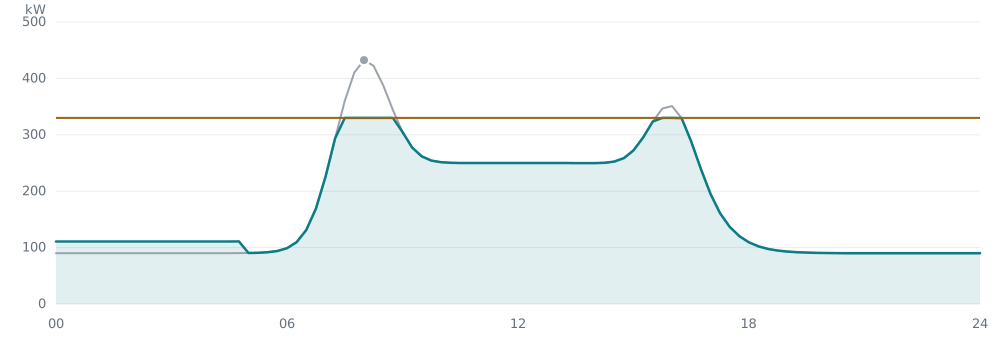
Illustration of a day in a commercial building.
A lower capacity charge
The capacity charge is set by the month's highest peaks. Lower peaks mean a lower capacity charge.
Cheaper electricity
The more wind and solar power there is, the more prices swing. The power market has had quarter-hour prices since October 2025, although many contracts still show an hourly price. PeakGuard moves load that can wait to the cheapest quarter-hours, without creating a new peak.
Room on your existing connection
Lower peaks leave room for more equipment without a bigger grid connection. That can save you a connection fee.
What PeakGuard controls
Moving load that can wait is often the easiest place to start. Whether the site also needs a battery is what the site analysis shows.
- Available now Heating, ventilation and hot water through the building control system (SD-anlegget)
- Available now EV chargers (OCPP) – cars get the energy they need by an agreed time
- Available now Battery from us. If you already have a battery, we check whether it can be controlled.
- Available now A warning before a new peak is set
- Available now Advice in the site analysis on load you can shift yourself, such as timers or staggered start-up
- Assessed per project Other process loads
Battery, when it is needed
Where moving load is not enough, a battery takes the rest of the peak. We size it from twelve months of meter data.
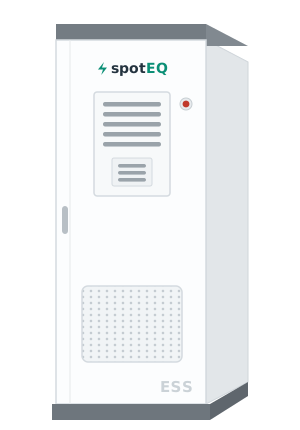
- 50 kWh modules in a cabinet that stands inside or outside – usually by the switchboard room or outside the building
- Lithium iron phosphate (LFP) cells with their own battery management system (BMS). PeakGuard keeps the battery within the limits set at installation.
- The battery is not backup power, unless the proposal says so
- If you already have a battery, we check whether PeakGuard can control it before we make the proposal
The battery does not replace fuses or other electrical protection. Battery technical data →
How it works
A unit in your electrical cabinet, planning in the cloud and an app.
Measures every second
The unit reads the site meter every second and always knows what the site is drawing.
Plans every 15 minutes
Every 15 minutes PeakGuard makes a new plan for the next 48 hours, based on the quarter-hour prices in your price area, your grid company's tariff and expected load.
Controls within the limits
The unit follows the plan, adjusts to actual load and checks every command against the limits set at installation.
PeakGuard cannot be reached from the internet. The unit only connects outwards to the spotEQ cloud.
The PeakGuard app
The app runs in a web browser, as a subscription.
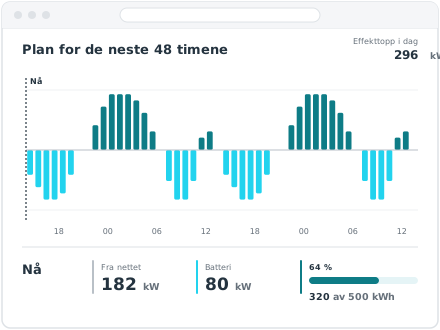
- The plan against actual operation, and the estimated saving compared with the same period without PeakGuard
- Alarms by email to the people you choose, for example if the site loses its connection
- Access per site and role, and a log of who changed what
Is PeakGuard right for your site?
PeakGuard is built for small and medium-sized businesses in Norway – such as grocery and retail, warehouses and workshops, hotels and office buildings and agriculture.
Signs that it will pay off
- Your grid tariff has a capacity charge (effektledd), and your peaks are short and predictable
- You know which equipment causes the peaks – kilns, compressors, dryers, refrigeration or charging
- Your grid connection is close to its limit, or you plan to add electric loads
- You have twelve months of meter data, or your grid company can provide it
If two or more apply, the site analysis will show whether it pays off. If none do, we will tell you that too.
What's included – and what it costs
A one-off cost for PeakGuard and installation, plus a monthly subscription for the app with monitoring, alarms and support. Both are stated in the proposal.
- PeakGuard and a site meter on the main incomer
- Connection to the building control system and EV chargers, when the proposal includes it
- Battery with cabinet and inverter, when the site needs one
- Electrical work, commissioning and a test period
- App access for the people you choose, and support as agreed
Not included: a larger grid connection, and electrical work beyond the installation. The price depends mostly on whether the site needs a battery, how large it must be, and how much installation work is needed. Pilot sites are on terms agreed individually.
How a project runs
Four steps from meter data to automatic operation. Nothing is ordered before you approve the proposal.
1. Free site analysis
We show where the peaks come from, and whether the site needs a battery – about a week after we receive your meter data from Elhub.
2. Proposal
What will be controlled, the price and the estimated saving, with the assumptions behind it. One to two weeks after the analysis.
3. Installation and test period
PeakGuard makes its plans but controls nothing yet. We compare the figures with your invoice.
4. Automatic operation
We switch on control once you have approved.
The saving is an estimate. Your invoices are what count – hence the test period. PeakGuard does not replace fuses or other electrical protection, and does not provide backup power during outages unless agreed.
Faults and maintenance: see the FAQ. Technical details are in the technical reference.